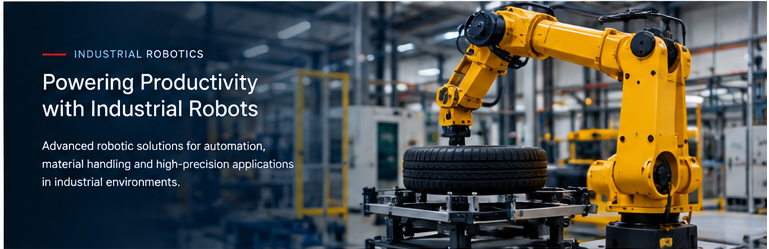
Industrial robotics solutions for automated production, material handling, machine tending and demanding industrial applications.
Industrial Robotics for Demanding Applications
Industrial robotics is more than the selection of a robot arm. Reliable robotic applications depend on the interaction between the robot, controller, production equipment, communication systems, operator interfaces, safety and the actual production process.
NIACO approaches robotics as an engineering system, combining robotic platforms with industrial computing, control, HMI, networking and integration technologies according to the application requirements.
The appropriate robotic architecture depends on the application, payload, reach, cycle requirements, connected equipment, control architecture, operating environment, safety requirements and expected lifecycle.
Typical Applications
NIACO industrial robotics solutions can support applications such as:
- Machine tending
- Material handling
- Pick and place
- Production line automation
- Robotic assembly
- Packaging and palletizing
- Automated handling operations
- Robotic production cells
- Equipment loading and unloading
- Integration of robots into existing production systems
Robotics Solution Architecture
An industrial robotics solution is built around the relationship between the robot, control system, production equipment and operating environment.
Robot Platform
The robot provides the motion capability required by the application, based on payload, reach, speed, accuracy and application requirements.
Robot Controller
The controller manages robot motion and provides the control interface required for integration with the wider automation system.
PLC & Industrial Control
PLC and control systems coordinate the robot with machines, sensors, actuators and other production equipment.
Industrial Computing
Industrial PCs and computing platforms can support application-specific processing, communication, monitoring, data handling and integration requirements.
HMI & Operator Interfaces
HMI systems provide operators with access to machine status, robot operation, alarms, production information and control functions.
Industrial Networking & Communication
Communication systems connect robots, controllers, PLCs, HMIs, industrial PCs and other equipment within the production environment.
Safety
Robotic systems require appropriate consideration of machine safety, operating zones, operator interaction and the overall safety architecture of the application.
From Requirement to Robotic Solution
NIACO approaches robotics from the actual application rather than from a robot model alone.
Understand
Understand the production process, application requirements, operating environment, payload, reach, cycle requirements and connected equipment.
Define
Define the appropriate robotic architecture, robot platform, control structure, interfaces and supporting technologies.
Integrate
Integrate the robot with PLCs, machines, HMI systems, industrial computing, communication systems and other production equipment.
Commission
Support implementation, testing, commissioning and operational validation of the robotic system.
Support
Consider maintainability, serviceability, modernization and long-term lifecycle requirements throughout the solution.
Relevant Technologies & Products
Industrial robotics solutions can combine different NIACO product and technology areas depending on the application.
Industrial Robots
Robotic platforms for automated production, material handling, machine tending and other industrial applications.
PLC Control Systems
Control platforms for coordinating robotic systems with machines, equipment and industrial processes.
Industrial PC
Industrial computing platforms for application-specific processing, communication, monitoring and integration.
Industrial Mini PC
Compact computing platforms for distributed control, monitoring, communication and application-specific industrial computing.
HMI Systems
Operator interface solutions for robot operation, machine status, alarms, process information and control functions.
Industrial Displays
Industrial display solutions for operator stations, production cells and monitoring environments.
Industrial Communication
Communication technologies required to connect robotic systems with PLCs, industrial PCs, HMI systems, machines and industrial networks.
Robotics Across Industries
Industrial robotics can support a wide range of industrial environments and applications.
Manufacturing
Robotic production cells, machine tending, material handling, assembly and production automation.
Automotive
Robotic production, machine tending, material handling, assembly and automated production cells.
Transportation & Logistics
Automated handling, material movement, equipment interaction and distributed operational systems.
Energy & Power
Robotic handling, equipment-related automation and industrial operations where automation can support demanding environments.
Infrastructure
Automated equipment handling, operational systems and application-specific robotic automation.
Pharmaceutical
Robotic handling, production support and automation applications within controlled industrial environments.
Engineering Considerations
Industrial robotics applications can require careful consideration of:
- Payload — Appropriate robot capacity for the required tooling, workpiece and application.
- Reach — Suitable working envelope for the required production process.
- Cycle Time — Robot performance appropriate to the required production rate.
- Accuracy & Repeatability — Motion performance appropriate to the application.
- Control Architecture — Coordination between robot controller, PLC, machines and other control systems.
- Communication — Reliable communication between robots, controllers, HMIs, IPCs and industrial networks.
- Safety — Appropriate safety architecture for the robot, cell, equipment and operator environment.
- Operating Environment — Temperature, humidity, dust, vibration and other site-specific conditions.
- Integration — Practical integration with existing production equipment and automation systems.
- Lifecycle Requirements — Maintainability, serviceability, compatibility, modernization and long-term availability.
Related Resources
Related Solutions
- Industrial Computing
- Industrial Automation
- Industrial Monitoring & Control
- HMI & Operator Interfaces
- AI Computing & Edge AI
- Machine Vision & Intelligent Systems
- Engineering & System Integration
Related Products
- Industrial Robots
- PLC Control Systems
- Industrial PC
- Industrial Mini PC
- HMI Systems
- Industrial Displays
Related Industries
- Manufacturing
- Automotive
- Transportation & Logistics
- Energy & Power
- Infrastructure
- Pharmaceutical
Have an Industrial Robotics Requirement?
Tell us what you need.
We will help you find the right starting point.